A fictional city council is deciding whether to pay for later library hours during a heat emergency. The library is one of the few places residents can reach after work, but it closes before many of them get home. The health department has records of heat-related illness, site hours, and bus routes. A community nonprofit wants residents to call council members in support of the funding. It asks the department to post that appeal through an outreach program paid for by a CDC grant. The request sounds like teamwork. It also changes what the department’s staff and grant dollars would be used to do.
What is the message asking people to do?
Advocacy is a broad word for supporting a cause or policy. Lobbying has a more specific legal meaning that depends on the activity and the rules governing the speaker. In this example, a brief that explains the heat risk, compares later hours with other options, and gives the council the evidence is different from a message saying, “Call your council member and ask for a yes vote.” The second message refers to a pending decision and asks people to influence it. The IRS description of lobbying includes urging the public to contact legislators to support or oppose legislation, including action by a local council.
The department and the nonprofit are separate speakers. The department is using public staff time and a federal award. The nonprofit has its own leadership, tax status, and funding. Residents can speak about their own experience. A useful first question is concrete: Who will write, pay for, send, and sign this particular message? Calling it “education” does not change a sentence that asks for a vote. Calling every discussion of policy “lobbying” would also obscure the department’s legitimate work.
Follow the grant dollars into the work
The nonprofit’s request has a funding consequence. A grant restriction is a condition on how an award’s funds may be used. Here, the proposed appeal would use grant-funded staff and the department’s outreach channel to ask the public to contact council members about a pending measure. CDC’s anti-lobbying guidance for grant recipients lists that kind of grassroots lobbying among restricted uses of CDC appropriated funds. Grassroots lobbying means urging other people to contact decision makers for or against a specific action. The same guidance describes activities that can be funded, including research on policy alternatives and educating the public about health risks and the evidence for possible solutions.
The restriction follows the work paid for by the award. If a CDC-funded employee drafts the appeal, a grant-funded contractor designs it, or the grant pays for its distribution, changing the logo to the nonprofit’s does not settle the funding problem. The director should check the actual award terms with the grants officer, identify which staff time and channels the award supports, and keep an accurate record of the decision. CDC’s guidance is a general overview, and it describes some normal executive–legislative communications by state or local government recipients differently from a public call to action. The department should get a review of the specific proposal rather than turn that distinction into a universal shortcut.
The restriction does not require silence about the heat policy. The CDC policy-process guidance describes governmental public-health work that includes defining the problem, analyzing options, communicating evidence, engaging people affected, and evaluating what happens. The director can ask, “What can our program explain clearly with the funds and authority we have?” That leads to a more useful product for the council and residents than a cautious silence.
Give the council evidence it can use
The department prepares a policy brief, a short evidence summary for the decision before the council. How many evenings would the library stay open? Which residents can reach it by bus or on foot? What would staffing, security, and accessible entry require? Would a nearer cooling site or transport support address the same gap? Heat-related illness data help show the stakes, but they do not prove that later library hours alone will prevent a particular number of visits. The brief should show what is observed, what is predicted, and what the department still needs to learn.
Residents’ accounts belong in that evidence. A person who arrives after the doors close can describe a failure that a site count misses. The department can invite those accounts and explain how they changed the options, while avoiding the claim that a few speakers represent everyone facing heat. A balanced brief also includes costs and obstacles that might weaken the department’s preferred option. It should carry enough context that a clipped sentence remains understandable without a follow-up press briefing. CDC’s grant guidance distinguishes objective, broadly shared analysis from materials designed to push a specific action with a call to contact lawmakers. The department can make its evidence available to the council and the public through its authorized channels.
Let the nonprofit speak in its own name
The nonprofit may decide to urge a yes vote. A section 501(c)(3) organization is a type of tax-exempt organization with limits on lobbying; the IRS says such organizations may do some lobbying, while too much can jeopardize that status. Its own grants and contracts may impose further limits. The nonprofit’s leadership should check those rules for its proposed campaign and pay for any permitted activity with appropriate resources. The county director should not give it a blanket legal approval or use it as a quiet way to send a message the department cannot fund.
The two organizations can still work from the same public facts. The department can share its published brief, correct a mistaken bus time, and answer questions about what the data mean. The nonprofit can decide what position to take and identify itself when it asks for a vote. Residents can tell council members what happened on a hot evening. People listening should be able to tell whose evidence they are hearing and whose recommendation they are being asked to support. That clarity protects the nonprofit’s independent voice as well as the department’s credibility.
Check what the vote delivers
Suppose the council approves later hours. The health department then checks whether the library has staff, an accessible entrance, a usable route, and accurate public notices. It reports which evenings the doors actually stayed open and asks residents whether they could use the service. The CDC Policy Process treats implementation and evaluation as continuing parts of policy work. A successful vote can authorize resources; the test of the heat response is what residents can do with them.
The director can answer the nonprofit with a clear plan: the department will prepare and share the evidence, review the CDC award before assigning staff or channels to any message, and leave an independently funded appeal to the nonprofit’s own review and decision. The grant restriction changes who can send the proposed sentence and how the public-health work proceeds.
Practice questions
Question 1: trace the proposed message
A nonprofit asks the fictional health department to use CDC-funded staff and outreach channels to tell residents to call council members for a yes vote on later library hours. What should the director do?
- A) Send the appeal because it supports a health goal
- B) Check the award and agency rules, keep grant-funded work on factual analysis and education, and let the nonprofit review its own appeal
- C) Put the nonprofit’s logo on the appeal and charge the staff time to the grant
- D) Stop sharing all information about the heat problem
Show the answer and rationale
Answer: B) Check the award and agency rules, keep grant-funded work on factual analysis and education, and let the nonprofit review its own appeal. CDC guidance restricts using its appropriated funds to urge the public to contact lawmakers for a specific action. The department can still explain the problem and policy options. A different logo does not change who paid for the work.
Question 2: separate the speakers
The nonprofit wants to use its own unrestricted funds to ask for a yes vote and requests the department’s published heat-access brief. What response fits the two organizations’ roles?
- A) Refuse to share public data with anyone who has a policy position
- B) Let the nonprofit write the department’s official brief
- C) Share the public brief and correct factual errors; the nonprofit checks its tax and funding rules and speaks in its own name
- D) Promise that 501(c)(3) status permits unlimited lobbying
Show the answer and rationale
Answer: C) Share the public brief and correct factual errors; the nonprofit checks its tax and funding rules and speaks in its own name. Public evidence can inform different speakers. The nonprofit owns its advocacy decision and compliance review; the department remains responsible for accurate official information.
Sources and related reading
- CDC: Anti-Lobbying Restrictions for CDC Grant Recipients
- CDC: Roles in the CDC Policy Process
- CDC: Policy Process
- IRS: Lobbying by tax-exempt organizations
- NBPHE: CPH content outline
Humanities Moment
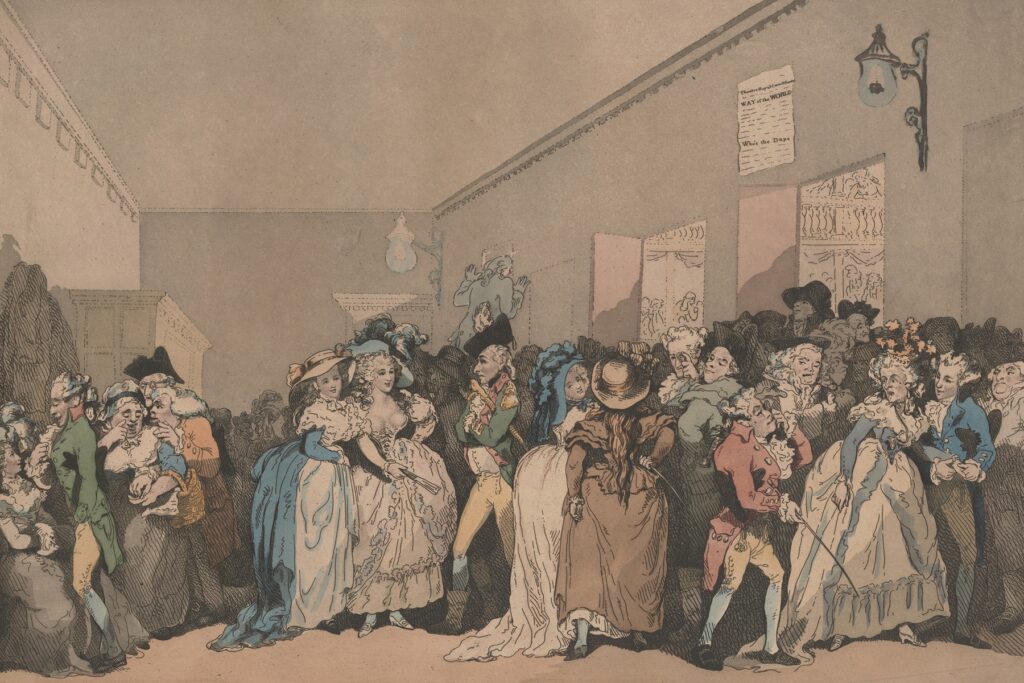
The featured image for this article is “Box lobby loungers (1787)” by Thomas Rowlandson. Thomas Rowlandson (1756–1827) was an English artist and printmaker of the Georgian Era, recognized for his prolific output of political satire and social observation. He produced individual caricatures of prominent figures like Napoleon Bonaparte and William Pitt the Younger, alongside extensive illustrations for novels and topographical works. His career included a six-year study at the Royal Academy and a successful partnership with publisher Rudolph Ackermann, which yielded popular series such as “The Tour of Dr Syntax”.